#Will taste save us?
Anthropic released Claude Fable 5 this week, its new Mythos-class generation and a step above Opus. It pitched the model as “dangerous” so convincingly that, three days later, a US executive order forced it to pull access in a hurry.
A project I’d shelved for two years
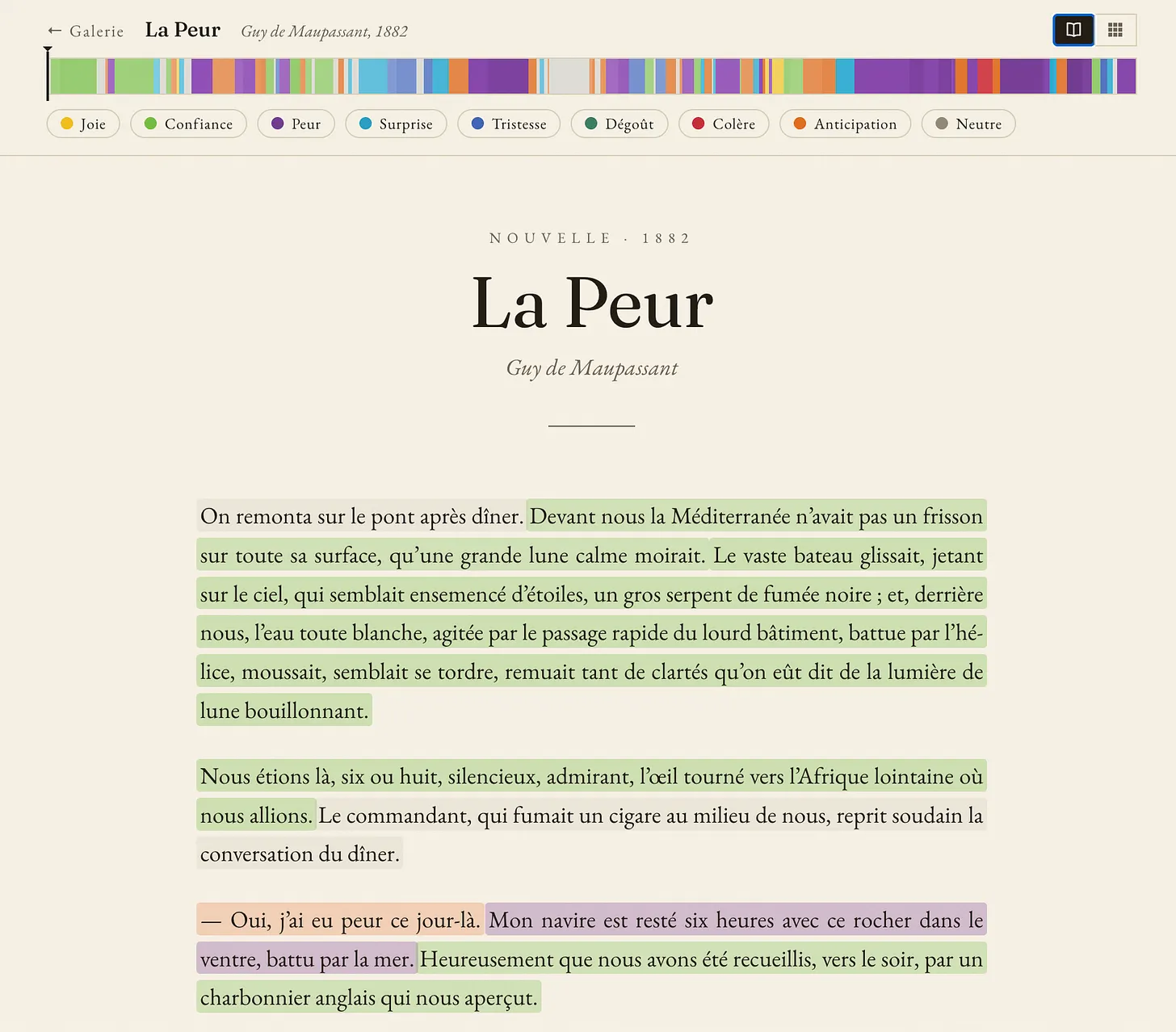
I got to test it during those three days. Official benchmark scores track real-world use less and less, so I ran my own test instead. I gave it a project I’d been saving for a long time: analyze the meaning of a text and color each sentence by the sentiment it carries. The goal is a very visual rendering of literary or political writing, an emotional map of prose that sits somewhere between data science, literature and art. It’s the kind of project that needs a free weekend, and I so rarely have one that the idea had been sitting on a shelf for two years.
In Claude Code, I typed a single prompt of a few lines, roughly the description above. After I hit Enter, Claude asked me two multiple-choice questions, then worked for almost twenty minutes without asking anything else. The result was excellent and covered more than 90% of what I had in mind.
See for yourself: prismatic-druid-40ac75.netlify.app
Less a developer, more a product manager
Could Opus have done the same? Probably, but with far more back-and-forth. Opus is technically excellent, and the coding here is well within its reach. But it would have asked me to approve the data sources and their format, the sample texts and the sentiment palette, and to settle a pile of interface questions.
Fable showed an autonomy, even a proactivity, I had never seen in a model. I noticed it immediately. It pulled sample texts from Wikipedia to match my tastes (19th-century literature, French politics). It chose Plutchik’s eight emotions as the taxonomy and gave each a color. It hooked into the Gemini API to classify the sentences, then built the backend and the interface end to end, without a single further question. What came back was close to perfect.
So the gap has less to do with code quality than with autonomy: making the (right) calls without stopping to check in at every ambiguity. Until now, handing Claude a project felt like briefing a fast, very capable developer. With Fable, it felt like briefing a product manager, someone who takes a vague goal, breaks it down, finds the material, resolves the open questions and comes back with a finished product instead of a list of questions.
Boris Cherny, who created Claude Code, said recently that he no longer keeps a to-do list. When a task comes up, he hands it to Claude instead of writing it down. That’s where models with more and more agency and judgment are taking us. My project had sat in the backlog for months, and a few sentences describing the goal turned it from an idea into something I could deploy.
When execution turns into judgment
This jump in capability undercuts an assumption that has been making the rounds among heavy AI users in recent months. The consensus was that even once we hand every technical and repetitive task to AI, humans would keep judgment and decisions. In a word, taste.
After one run with a stronger class of model, it looks like the line has moved further into territory we thought belonged to human decisions. What Fable produced in twenty minutes on its own wasn’t just execution. It was judgment.
Thinking it over, nothing suggests taste is harder to encode than anything else. Good taste doesn’t fall from the sky. It comes from massive exposure to work done well, distilled into intuition. An art director has an eye because they’ve seen ten thousand mockups; an editor, because they’ve read a thousand manuscripts. Massive exposure to work done well is, quite literally, how you train an LLM. We bet that judgment will hold because it feels like the most human thing we have. That bet may be sentimental rather than technical.
Still, let’s keep a cool head. One good weekend doesn’t make a rule, and the judgment built into Fable is averaged taste, the consensus of its training data. For my test, that was plenty: the job didn’t need distinctive taste, just sound taste. That layer may be the next to go. The ground we can defend shrinks with every model generation.
The open question now is when the model will be back for the rest of us. Axios has some interesting details on what happened behind the scenes. More to come.