#The prompt is the new style
Here’s a test.
Below is a passage from Huysmans’s 1882 novella À vau-l’eau (Downstream), in two versions. Gemini wrote one of them in thirty seconds. Can you spot the original?
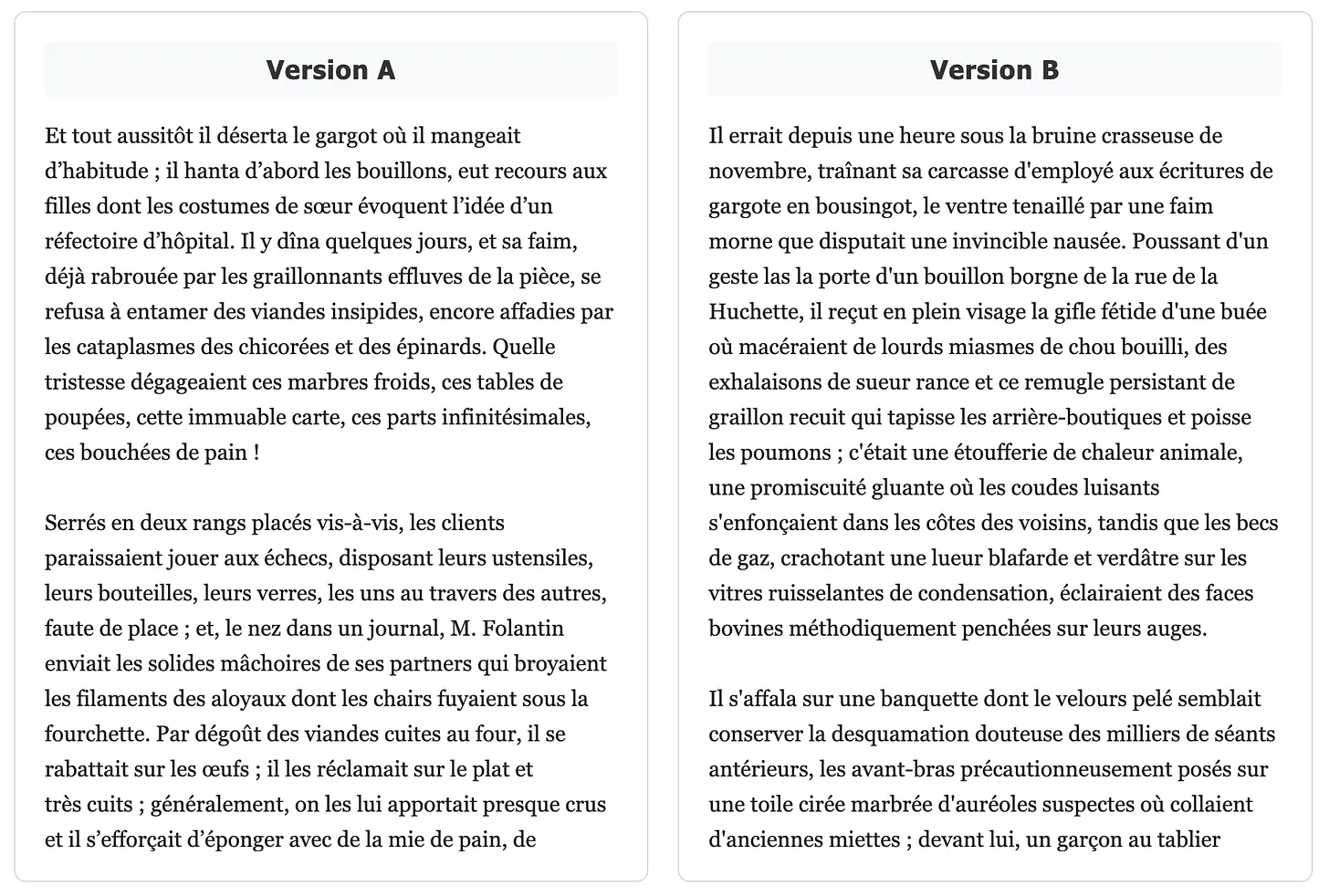
It’s harder than it looks. The original is version A. If you want to test your eye on other classics (Zola, Maupassant, Flaubert), I built a small app for that.
You probably hesitated, and that’s worth a closer look. Scroll through LinkedIn and you’ll come away convinced that AI writes badly, in a flat style you can spot a mile off. That’s true when it’s prompted badly. Most posts smell of ChatGPT from across the room: the stiff, dramatic tone, the cheap life lessons.
The problem isn’t the machine, though. It’s the instructions it gets.
An LLM is a language model, not a code model
Most of the hype is about coding and autonomous agents, so it’s easy to forget that a large language model is, by definition, a model of language. Code is one kind of language, with a handy property: you can check it objectively and instantly. That makes it easier to train models on.
It’s also why coding ability has improved so dramatically. When a program runs and passes its tests, the model knows it succeeded. When it fails, the error says exactly what went wrong. Feedback that fast makes reinforcement learning very effective. On top of that, the market for code is huge, and AI researchers are engineers who naturally optimize for the tools they use every day. Prose is subjective and harder to score. Nobody has built a compiler for literary style.
So AI can write. Few people know how to ask it. And to get good results you need the most capable models, currently Claude Opus 4.6, Gemini 3.1 Pro or ChatGPT 5.4 in “Thinking” mode, and not the fast or free tiers most people settle for.
To test this, I pushed the models as far as I could. I picked about twenty texts: 19th-century classics (Zola, Maupassant, Huysmans, Flaubert, Hugo), contemporary French fiction (Houellebecq, Carrère, Despentes) and newspaper editorials. Then I asked the models to imitate them.
Direct the model like an actor
The trick is to direct, not to copy.
Tell an AI to “write like Zola” and you get a crude pastiche built from everything the model already knows about Zola. I used two steps instead:
- One LLM analyzes the original’s style in detail: rhythm, syntax, vocabulary and register, atmosphere. It turns that into precise but anonymized instructions. The author’s name never appears.
- A second LLM writes a new text from those instructions.
The point is to capture the stylistic fingerprint without naming its owner. Instead of “write like Huysmans,” the prompt reads:
Realist and naturalist writer, a master of the sordid and of everyday mediocrity. Jaded, cynical, misanthropic tone. Broad, cumulative syntax: long sentences paced by semicolons and lists. Rich, contrasting vocabulary that mixes a formal register with the slang of the period. Avoid: heroism, romanticism, appetizing descriptions, short punchy sentences, any optimistic resolution.
That’s literary direction. The prompt works like a director’s note to an actor. It doesn’t supply the lines; it sets the frame the lines have to grow out of.
What the numbers say
A text can fool the ear, but can you measure how good the imitation is? Partly. I compared the originals and the generated texts on several linguistic metrics: sentence length, vocabulary diversity, syntactic depth, punctuation.
The biggest surprise was burstiness, the coefficient of variation of sentence length. Put simply, it measures how much a writer mixes short and long sentences. It’s how a text breathes. Human authors swing naturally between three-word sentences and forty-word ones. You’d expect an LLM to flatten that rhythm. It does the opposite.
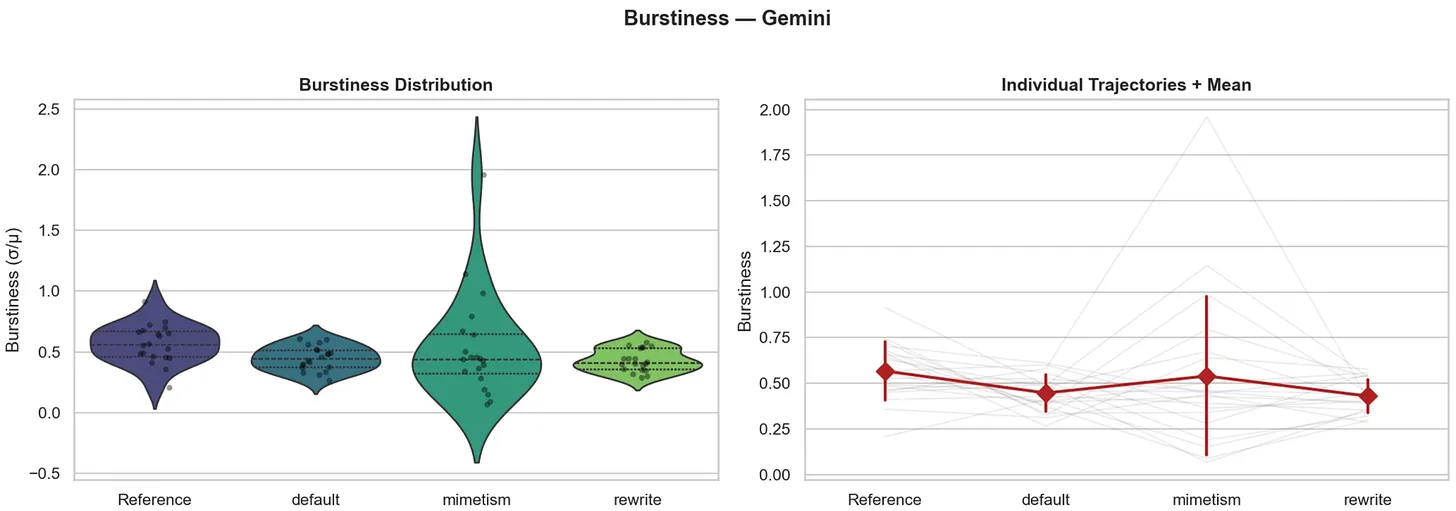
In “mimetic” mode, the setup with the most thorough upfront style analysis, the LLM doesn’t flatten anything. If anything, it overacts. Its vocabulary is more diverse than the original’s, and its syntax more complex. It has learned the rules of the style and applies them with a zeal the human author doesn’t bring to every sentence.
That runs against everything you read on the subject. LinkedIn slop isn’t a limit of AI. It’s the limit of people who use it without custom instructions.
Style you can write down
First, the technical point: output quality depends heavily on the prompt. A generic prompt gets you generic text. A prompt that pins down a rhythm, a register and a narrative stance gets you text that even a careful reader struggles to tell from the original. The gap between the two is no longer about the model. It’s about direction.
Second, the broader point. If literary style breaks down into parameters (rhythm, syntax, register, lexical density), and a machine can take those parameters and execute them competently, then style isn’t the untouchable human stronghold we like to think it is. The great authors stay out of reach. Their originality comes from a vision, a way of seeing the world that is theirs alone, and no set of reproducible parameters captures it. Proust is more than long sentences and semicolons.
For everyone else (copywriters, journalists, storytellers), the ground has moved. AI can pick up patterns in a text that our brains sense without ever spelling out, then reproduce them more consistently than we can. You might have thought style was humanity’s last refuge from the machine. Maybe it was just the last field where nobody had bothered to write the right prompt.