#How I use live open data for Paris Vélib
Since July 2022, I fetch the inventory of roughly 1500 Paris Velib stations every 5 minutes from the open source API, and stream it in a BigQuery dataset. That’s half a million rows per day. Then, to reduce raw tables size, and to prepare data for visualizations, I have scheduled a number of transformations in a GCP-native ETL pipeline, entirely with BigQuery Scheduled Queries and GCP Cloud Scheduler+Pub/Sub+Cloud Functions.
Everything is run with no-ops GCP functions, and no maintenance has been required for more than a year. The montly cost for the whole process and storage is modest, less than 5€ per month.
The final data is exposed in real-time as maps and tables with Looker Studio, and can be seen on the Vélib tracker:
ETL pipeline
Schematically, this is the data architecture of the ETL pipeline:
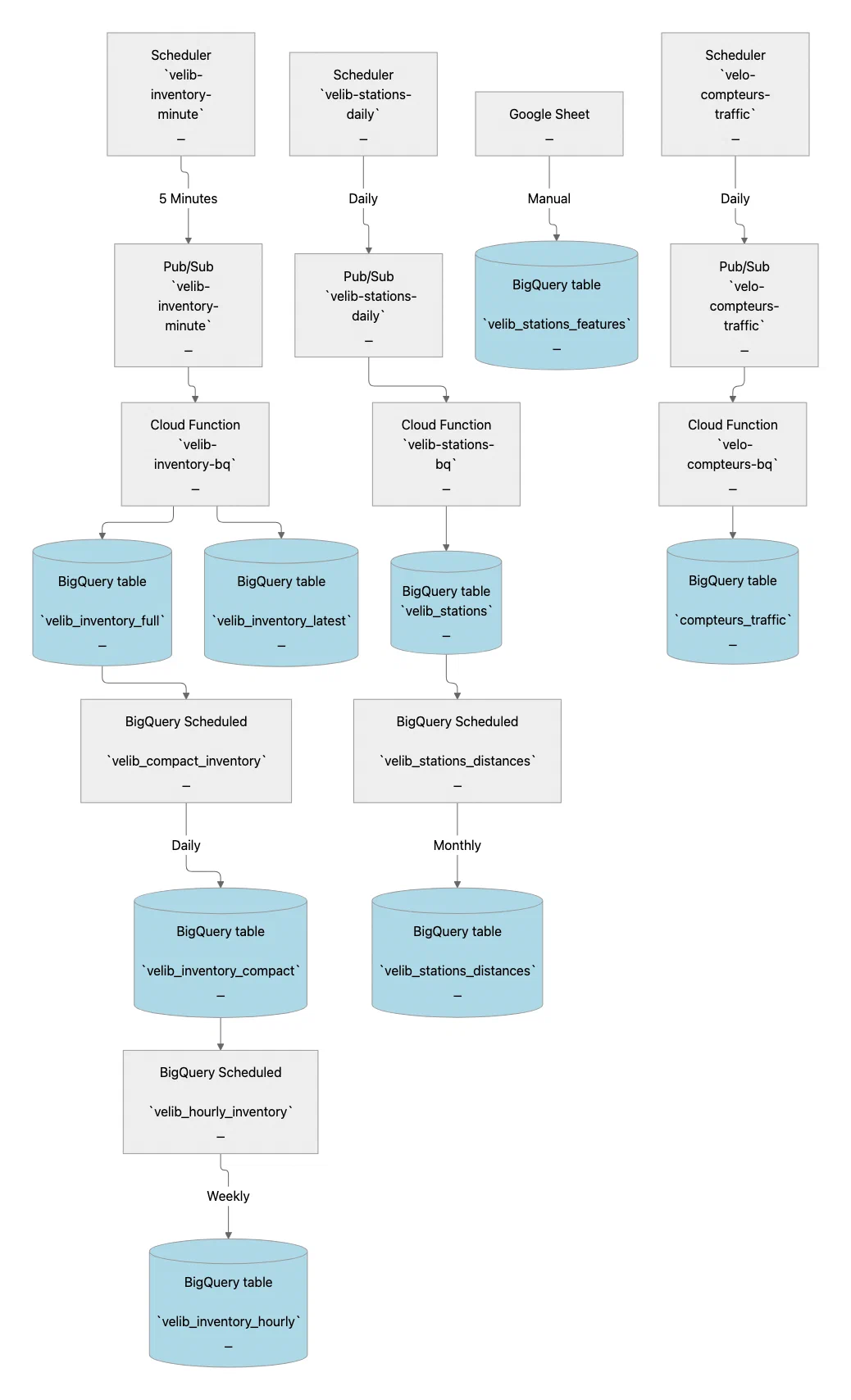
BigQuery tables
7 BigQuery tables are generated, accounting for about 4GB of storage per year:
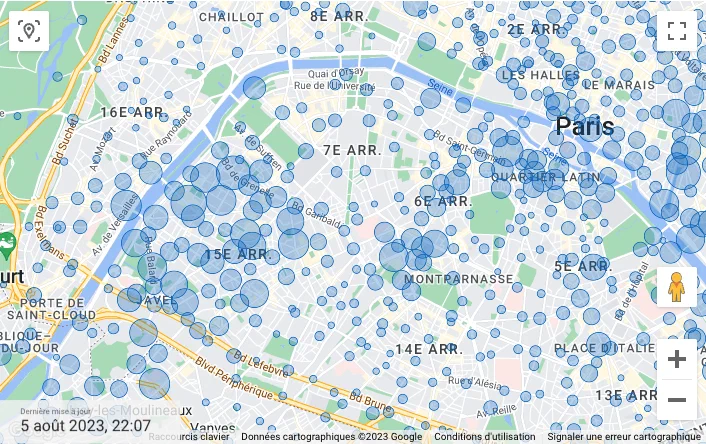
velib_inventory_latestgets latest inventory update for every station. The table is truncated at each API call, every minute.- Update frequency:
5 minutes - Usage: map of live Vélib inventory
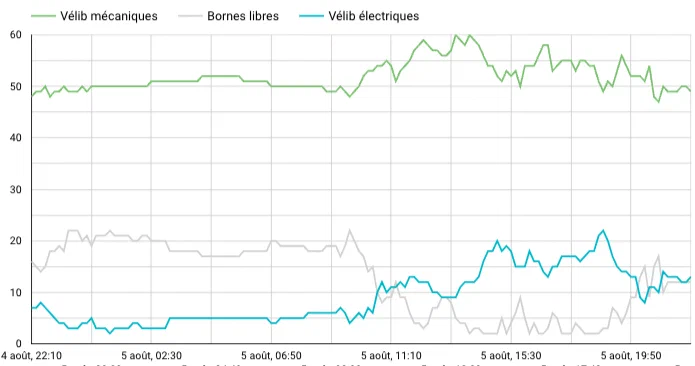
velib_inventory_fullkeeps the full inventory, at every minute, of each Vélib station for the last 2 days. A row is appended at each API call, for every station.- Update frequency:
5 minutes - Usage: inventory of last 24 hours for each Vélib station
velib_inventory_compactis a “compacted” version of the full inventory tablevelib_inventory_full. All duplicate consecutive rows are removed, which reduces the number of rows by about 90%.- Update frequency:
daily
WITH sub1 AS (
  SELECT
    *,
    LAG(num_docks_available) OVER (PARTITION BY station_id ORDER BY updated_at) AS lag_num_docks_available,
    LAG(num_bikes_available) OVER (PARTITION BY station_id ORDER BY updated_at) AS lag_num_bikes_available,
    LAG(num_bikes_available_mechanical) OVER (PARTITION BY station_id ORDER BY updated_at) AS lag_num_bikes_available_mechanical,
    LAG(num_bikes_available_ebike) OVER (PARTITION BY station_id ORDER BY updated_at) AS lag_num_bikes_available_ebike
  FROM `sandbox-246007.parigovelo.velib_inventory_full`
  WHERE
    DATE(updated_at) = DATE_SUB(CURRENT_DATE(), INTERVAL 1 DAY)
),

sub2 AS (
SELECT
  sub1.*,
  IF(
    lag_num_docks_available IS NULL
    OR lag_num_docks_available != num_docks_available
    OR lag_num_bikes_available != num_bikes_available
    OR num_bikes_available_mechanical != lag_num_bikes_available_mechanical
    OR num_bikes_available_ebike != lag_num_bikes_available_ebike,
  updated_at, NULL) AS last_updated_at
FROM sub1
)

SELECT DISTINCT
  station_id,
  num_docks_available,
  num_bikes_available,
  num_bikes_available_mechanical,
  num_bikes_available_ebike,
  is_installed,
  is_returning,
  is_renting,
  last_updated_at
FROM sub2
WHERE last_updated_at IS NOT NULLvelib_stationslists each Vélib station with its attributes such as name, coordinates and capacity. Attributes are not supposed to change often, so there’s only a daily check from Vélib API – and it’s still overkill, but it’s cheap to store.Update frequency:
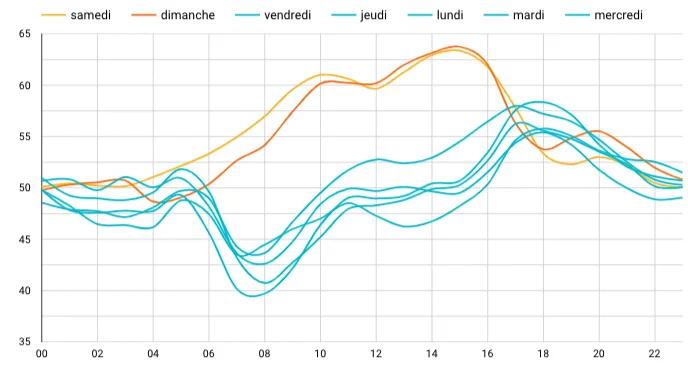
dailyvelib_inventory_hourlycomputes the average inventory by hour and weekday, over the last 30 days, for each station.Update frequency:
weekly
/* Create hourly grid with a special BigQuery function */
WITH slots AS (
    SELECT
        slot AS time_slot
    FROM UNNEST(GENERATE_TIMESTAMP_ARRAY(
        (SELECT TIMESTAMP(MAX(time_slot)) FROM `parigovelo.velib_inventory_hourly`),
        TIMESTAMP(DATE_SUB(CURRENT_DATE(), INTERVAL 1 DAY)),
        INTERVAL 1 HOUR
    )) AS slot
),

/* Get latest stations information */
stations AS (
    SELECT DISTINCT
        station_id,
        station_code
    FROM `parigovelo.velib_stations`
    WHERE updated_at = (SELECT MAX(updated_at) FROM `parigovelo.velib_stations`)
),

/* Join grid of hourly slots with stations */
slots_stations AS (
    SELECT
        slots.time_slot,
        stations.station_id,
        stations.station_code
    FROM slots
    CROSS JOIN stations
),

/* Find average and last updated inventory for each timeslot and each station */
inventory AS (
    SELECT
        slots_stations.time_slot,
        slots_stations.station_id,
        slots_stations.station_code,
        MIN(inv.last_updated_at) AS slot_first_update_at,
        MAX(inv.last_updated_at) AS slot_last_update_at,
        AVG(inv.num_docks_available) AS avg_num_docks,
        AVG(inv.num_bikes_available_mechanical) AS avg_num_bikes_mechanical,
        AVG(inv.num_bikes_available_ebike) AS avg_num_bikes_ebike,
    FROM slots_stations
    LEFT JOIN `parigovelo.velib_inventory_compact` AS inv
        ON slots_stations.station_id = inv.station_id
        AND inv.last_updated_at < DATE_ADD(slots_stations.time_slot, INTERVAL 1 HOUR)
        AND inv.last_updated_at >= slots_stations.time_slot
    GROUP BY 1,2,3
),

/* Fill in the blank update times */
inventory_full AS (
    SELECT
        inventory.*,
        LAST_VALUE(inventory.slot_last_update_at IGNORE NULLS) OVER (
            PARTITION BY inventory.station_id
            ORDER BY inventory.time_slot
            ROWS UNBOUNDED PRECEDING
        ) AS latest_update_at
    FROM inventory
)

/* For empty time slots, get the latest previous inventory */
SELECT
    inv_full.time_slot,
    inv_full.station_id,
    inv_full.station_code,
    inv_full.latest_update_at,
    COALESCE(inv_full.avg_num_docks, fill.num_docks_available) AS avg_num_docks,
    COALESCE(inv_full.avg_num_bikes_mechanical, fill.num_bikes_available_mechanical) AS avg_num_bikes_mechanical,
    COALESCE(inv_full.avg_num_bikes_ebike, fill.num_bikes_available_ebike) AS avg_num_bikes_ebike,
FROM inventory_full AS inv_full
LEFT JOIN `parigovelo.velib_inventory_compact` AS fill
    ON inv_full.station_id = fill.station_id
    AND inv_full.latest_update_at = fill.last_updated_at
ORDER BY station_code, time_slot- Usage: hourly availability graph
velib_stations_distancescomputes the distance between each station and all others, which is used for getting nearby stations. For 1500 stations, the query is computationally quite expensive.- Update frequency:
monthly
WITH sub1 AS (
  SELECT DISTINCT
    station_id,
    station_code,
    latitude,
    longitude
  FROM `parigovelo.velib_stations`
  WHERE
    station_code IS NOT NULL
    AND latitude IS NOT NULL
    AND longitude IS NOT NULL
),

sub2 AS (
  SELECT
    station_id,
    station_code,
    ST_GEOGPOINT(longitude, latitude) AS coord
  FROM sub1
),

sub3 AS (
  SELECT
    stn_from.station_id AS station_from_id,
    stn_to.station_id AS station_to_id,
    stn_from.station_code AS station_from_code,
    stn_to.station_code AS station_to_code,
    CAST(ST_DISTANCE(stn_from.coord, stn_to.coord) AS INT64) AS distance
  FROM sub2 AS stn_from
  CROSS JOIN sub2 AS stn_to
)

SELECT DISTINCT *
FROM sub3
WHERE
  station_from_id != station_to_id
  AND distance <= 1000
ORDER BY station_from_code, distancevelib_stations_featuresprovide additional attributes for each Vélib station, coming from a manual Google Sheet.- Update frequency:
manual