#Evaluating AI-generated text before deployment
As with any tech project, there’s one simple question to answer before deploying an AI system: “How do we know we’re ready?”
Except we’re nowhere near the maturity of classic data science projects, where the evaluation metrics are well established: accuracy, recall, precision… None of that applies directly to judging how good a generated text is.
Over the past few months, I’ve had to evaluate the quality of AI-generated text at scale. How do you check that a chatbot stays on topic? Or that 300 automatically generated marketing texts hold up? Past a few dozen examples, having humans read everything stops being an option.
So you combine several approaches to evaluate a generation system before it goes to production:
Human evaluation. Essential at first. Reading lots of examples, and above all getting the business teams to read them, is how you refine the system, and the prompts in particular.
Computed metrics.
- The basics: text length, presence of certain keywords, URL detection, etc.
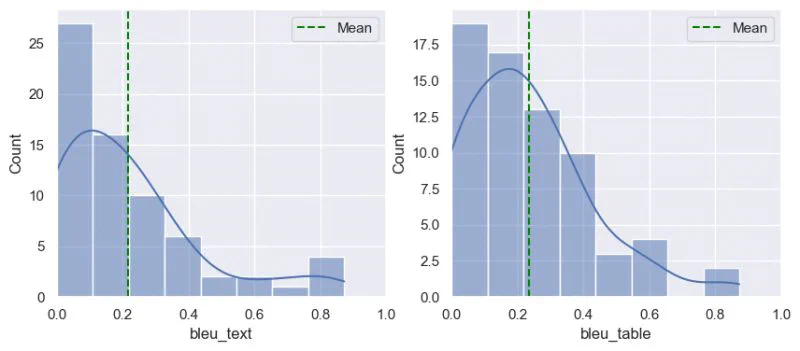
- More advanced ones: BLEU, cosine similarity, etc., to measure the distance from reference texts. Useful, but often too shallow to judge actual relevance.
- “LLM-as-a-judge”. A more recent approach: have another LLM grade the LLM’s output (welcome to Inception). You hand it a rubric (relevance, tone, factuality, etc.) and it scores the results. Not foolproof, but good enough to compare prompt versions against each other, or catch a drop in quality at scale, without pulling in a whole team.
And above all, don’t treat evaluation as a sprint right before launch. As with a classic data science project, performance has to be evaluated continuously, with user feedback folded in.