#Claude Artifacts and home-cooked software
I use Artifacts in Claude.ai a lot. Anthropic launched them last summer: self-contained pieces of content that Claude displays in a separate panel, outside the chat, and updates as you give it new instructions.
That can be as simple as a text or Markdown document you refine over the course of the conversation, without copying and pasting the changes back in every time.
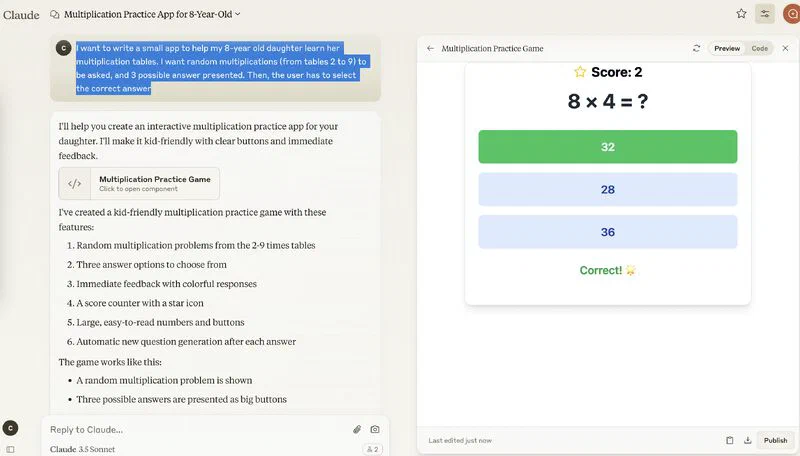
The real revolution, though, is being able to generate a small app live. You don’t need to know how to code anymore. Just say clearly what you need, in plain language (special shout-out to Product Managers). Claude writes the code and shows you the result in real time, in its own panel.
For example, it took me 5 minutes to build a little educational game to help my daughter, who is in fourth grade, practice her multiplication tables. You give feedback as you go (“make the button bigger, change the color”) and the app updates instantly. Then you export it and use it anywhere.
In response to Anthropic, OpenAI is starting to roll out ChatGPT Canvas, and GitHub has just announced Spark.
The barriers to entry for software development are collapsing right now, at least at the junior level. Today you can build and deploy a small application in under an hour without knowing, or writing, a single line of code.
Maggie Appleton describes the rise of “home-cooked software”: built for very specific needs, often just for the family. And indeed, with the new AI tools, even your grandmother can now put together a micro-app in React, hook it up to the Nest camera in the kitchen, and get an alert whenever a cookie theft is detected 🥷🍪