#AI isn’t the junior you were promised
The talented junior metaphor has run its course. Everyone reached for it to explain AI: a fast, technically capable assistant with no judgment, who needs a human to point it somewhere useful. A junior can hand you work that is technically flawless and strategically beside the point. The senior steers, reframes and makes the calls. The hierarchy held: AI executed, humans thought. That was true until 2025.
Say “technical tasks” and most people think of code, the go-to example. But code is only one slice. Recent models already match a qualified junior, at ten to a hundred times the speed, across a wide range of work: meeting notes, legal drafting, briefing memos, financial models in spreadsheets, first drafts of slide decks.
A Stanford study already shows the shift. Since ChatGPT came out, employment among workers under 30 in the most exposed jobs (software developers, customer support agents) has fallen, while employment among senior workers has held steady or grown. Experience still pays. For how long?
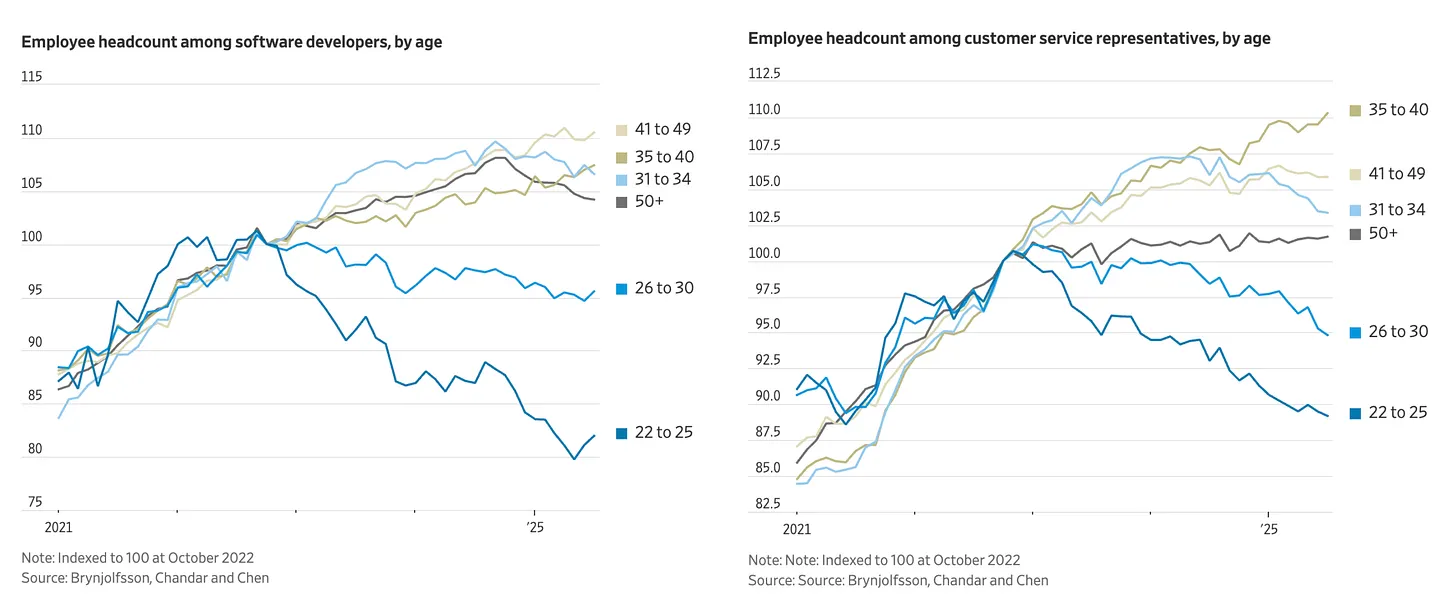
In some fields, experience has already nearly lost its edge. Data science is one of them.
When the senior isn’t in the room
A client recently asked me to find, in their customer database, the people most likely to buy a financial product they didn’t own yet. The point was to give the sales team a priority call list for upselling.
Data science is a team sport. To keep from disappearing into endless analysis, you need to show your work to a peer regularly: someone who will actually read the notebook in progress, question the leads you’re chasing and keep you focused on the business goal, instead of drifting into technical detours that add nothing.
On this project I was working alone. Predictably, I went down dead ends, and faster than ever, since AI now makes writing code ten times quicker. What I needed was a peer: a senior data scientist.
So I changed the kind of questions I asked Gemini. I stopped asking it to write Python functions and moved up to strategy: “Here’s my notebook and my thinking. Act as a senior data scientist. Tell me what you think and where you’d dig next.”
The answer was as good as anything I got from my most experienced former colleagues. Gemini opened with a precise question I hadn’t managed to put clearly to myself: in this database, what exactly counts as a customer with “high upsell potential”? Then it proposed a different angle. Plain propensity modeling, nothing exotic, but I’d missed it because I was stuck in a mental rut. The code came after. What mattered was the strategic reframe, not the code.
Used well, AI is no longer only the junior you hand the technical plumbing to. It can act as a senior peer who has read everything, from Hastie & Tibshirani’s statistics textbooks (the field’s standard references) to the Medium posts from the data teams at Netflix and Airbnb. A peer who reads your work in progress closely, comments point by point, and has unlimited time for you at any hour. In my own field, on this kind of work, it already performs at the level of a senior data scientist. And it won’t pencil you in for thirty minutes next Friday, between two meetings.
What never makes it into the brief
So what’s left for humans? Two or three things, for now.
First, talking to the business teams to understand what’s really at stake, the things nobody writes in the brief. AI doesn’t sit in meetings. It doesn’t pick up on what goes unsaid, and it doesn’t know the history of friction between the marketing director and the CIO. Second, connecting the analysis to what the organization can actually execute, which means knowing its invisible constraints and the trade-offs they force. Third, deciding when the work is ready to ship. AI will iterate forever and never tell you on its own that you’ve dug deep enough. (Then again, I know a few people like that.)
None of these is a technical skill. They are political, social and organizational skills.
Stance is what matters now
Between two data scientists with similar résumés, the productivity gap already depends less on technical skill than on how they approach AI. The ones who still treat it as an intern, giving it the boring code and keeping the “real work” for themselves, are living in 2024. The ones who use it as a sparring partner, who let a machine challenge them but know when to take back control, will work more efficiently and go deeper.
AI gives an outsized advantage to people who have learned to think, whatever their age or seniority. Some seniors will keep treating it as an intern and fall behind. Some juniors already know how to push it to its limits, because they had a demanding mentor, rigorous training, or simply the habit of challenging it rather than consulting it. What counts now is the quality of the thinking you built before you ever met the machine, not your years of experience.
This gap in how people use AI will quickly reshuffle the skills hierarchy in every kind of knowledge work. Everyone has access to AI, so access won’t decide who comes out ahead in the years to come. Stance will. And you don’t learn that stance by using AI. You learn it before.